The Menopause Diet Question: How Women in Their 40s and 50s Are Finally Losing the Hormonal Belly in 2026
If you've spent the last two years eating less, walking more, and watching the scale refuse to move — there's a biological reason for that. And no, it isn't willpower. Here's what's actually happening to women's bodies after 40, why the old rules stopped working, and the gentle morning approach women in midlife are quietly using to finally lose the menopause belly without dieting harder.
Let's start with the part most articles tiptoe around: weight loss for women over 50 doesn't follow the same rules as weight loss at 35. Or 30. Or any age you remember being able to drop ten pounds by cutting out wine and walking on weekends.
You can do everything you used to do — same dinner portions, same morning fast, same Pilates class — and the body that responded for thirty years simply… stops cooperating. The number on the scale either holds, or creeps. The shirts you wore last summer feel different around the middle. There's a layer there that didn't exist five years ago, and it's not the kind of fat you can pinch — it's the kind that sits under your skin, around your organs, lower and firmer.
You're not broken. You're not lazy. You're not eating wrong. What you're seeing is biology — specifically, what happens to women's bodies during the menopause transition. And until someone explains that piece honestly, every "menopause diet" guide on the internet is going to feel like it was written for a body that isn't yours anymore.
This is the version your friend who actually figured it out would tell you over coffee — without the bullet points, without the supplement sales pitch, and with the part about the gentle morning routine she'd probably also mention before you left.
Chapter 01What Actually Changes in a Woman's Body After 40
At the start of the menopause transition — usually somewhere between 42 and 52, but it varies — three things start happening at the same time. Most articles cover one of them. Almost none cover all three.
- Estrogen begins falling. For most of your adult life, estrogen was telling your body to store body fat in your hips and thighs — what people call the "pear shape." When estrogen drops, that storage map gets redrawn. Fat moves to the abdomen. This is what women describe as the estrogen belly: a belly that wasn't there at 38 and won't leave at 52, no matter what you eat.
- Resting metabolism slows. Not by 1 or 2%. Recent research suggests an average drop of 5 to 7% in the first 18 months of the menopause transition. That sounds small until you do the math: the same lunch you ate at 40 now leaves an extra 80 to 120 calories sitting on your waistline every single day.
- Your fullness signal weakens. A satiety hormone called GLP-1 — yes, the same one those famous prescription pens copy synthetically — drops as estrogen drops. So you feel hungry sooner. You feel less satisfied. You eat the exact same dinner you did ten years ago and an hour later you're standing in front of the pantry, confused and a little angry.
This isn't theory. A landmark 4-year longitudinal observation published in the International Journal of Obesity followed women through the menopause transition and found that women who became postmenopausal had significantly increased visceral abdominal fat alongside decreased energy expenditure — even when their reported diet and activity stayed the same. (You can read the abstract on PubMed here if you're a research-reader.)
Translation: weight gain after menopause isn't a willpower problem. It's a hormone problem dressed up as a willpower problem.
The "hormonal belly" is real. When women describe a menopause belly or hormonal belly that suddenly appeared and won't go away — they aren't exaggerating. The fat literally redistributed from one part of the body to another. It's a biologically different pattern of fat storage. That's why the diets that worked at 35 don't touch it. The good news? The same hormonal logic that creates this belly also tells us, very clearly, what to do about it.
Chapter 02Why "Eat Less, Move More" Is the Worst Possible Advice After 40
If you've ever cut your calories down to 1,200 a day for two weeks and watched the scale not budge — congratulations, you've already discovered what researchers are now openly admitting in the menopause literature: aggressive calorie restriction during the menopause transition makes things worse, not better.
Here's the mechanism. When estrogen is low and you slash calories, your already-slowed metabolism slows further. Your body, sensing scarcity, clings to body fat for dear life — especially the visceral abdominal fat, because biologically it's the body's emergency reserve. You end up tired, irritable, hungrier than you've ever been, and the same weight you started.
This is the part most "menopause diet to lose weight" articles get exactly backwards. They prescribe more restriction. What actually works during perimenopause and after menopause is specificity — eating in a way that supports the hormones you have left, not punishing yourself for the ones you've lost.
The women who finally crack this almost always describe the same turning point: the morning they stopped trying to force their body to lose weight and started asking it to.
You can't out-restrict a hormonal shift. You have to out-strategy it.
Chapter 03Foods to Avoid for Menopause Belly Fat (Yes — Even the "Healthy" Ones)
This is where it gets uncomfortable, because some of the foods that sabotage your belly after 40 are foods with a wholesome reputation. The most common offenders we see in our reader community, ranked by how often they show up:
- Refined seed oils — sunflower, soybean, corn, canola. They're in nearly every packaged food and most restaurant cooking. They drive low-grade inflammation, and inflammation is what makes hormonal belly fat cling instead of release.
- "Healthy" granolas and protein bars — most contain more added sugar than dessert, and that sugar spikes insulin in a body that's already insulin-resistant from the estrogen drop.
- Plant-based milks with carrageenan — common additive in almond, oat, and soy milks. Linked to gut inflammation, which directly disrupts the GLP-1 signal you're already short on.
- Fruit juices marketed as "detox" or "cleanse" — pure fructose with no fiber. Goes straight to the liver, which after menopause is far less efficient at processing it.
The pattern is the same: foods that look healthy on the label but don't match the chemistry of a postmenopausal body. The fix isn't more discipline. It's better information — and increasingly, simpler delivery.
Chapter 04What's Actually Working: The Surprisingly Simple Routine Going Around with Women 40+
Here's what's been interesting to watch. The women in our reader community who are actually losing the menopause belly aren't on extreme protocols. They're not doing 18-hour fasts. They're not eliminating entire food groups. They're not on the prescription pens (or they tried, and quit).
They're doing something much smaller. Most of them describe it almost word-for-word the same way:
"One little thing in the morning. That's all I changed."
That "one little thing" — across women in their 40s, 50s, 60s, and even 70s — turns out to be a small daily routine that satisfies four conditions at once. And it's the four together that makes it work, not any one of them alone:
1. Plant-pigment polyphenols (the "green" component)
Specifically green tea extract. These compounds activate the sirtuin pathway — basically a "cellular cleanup" mode that supports natural fat oxidation. This is the family of compounds powering what's been trending lately as the green jelly diet — and it's not as fringe as the name sounds. The compounds are well-studied. What's new is the delivery format.
2. Collagen-rich protein for GLP-1 support
Pure bovine gelatin contains glycine and alanine, two amino acids that — in recent European nutritional research — appear to support natural GLP-1 and GIP signaling. The same satiety hormones the famous pens try to mimic synthetically. For women over 50, this matters more quietly but more importantly than almost anything else: it's how you get the "I'm full" signal back without an injection. Some readers have asked whether this is the same idea behind the so-called bariatric gelatin recipe circulating online — and the underlying logic is similar, yes: the goal is to support GLP-1 the body's own way.
3. A bioactive that calms menopause symptoms (this part surprised us)
Lemon peel contains a bioactive compound that — beyond its role in fat metabolism — was recently shown in midlife women's health research to reduce hot flashes, sleep disruption, and low energy in women over 50. So the same morning routine that targets the belly is, almost incidentally, also calming the symptoms making midlife exhausting. This is the part most women find genuinely surprising once they try it.
4. A 30-second window of consistency
The single most underrated factor: doing one small thing every morning, in the same order, on an empty stomach. That's it. Consistency at one specific window — not perfection across the day — is what produces results in a postmenopausal body. The simpler the routine, the more likely you actually do it on day 19, day 47, day 88. Which is when the body finally responds.
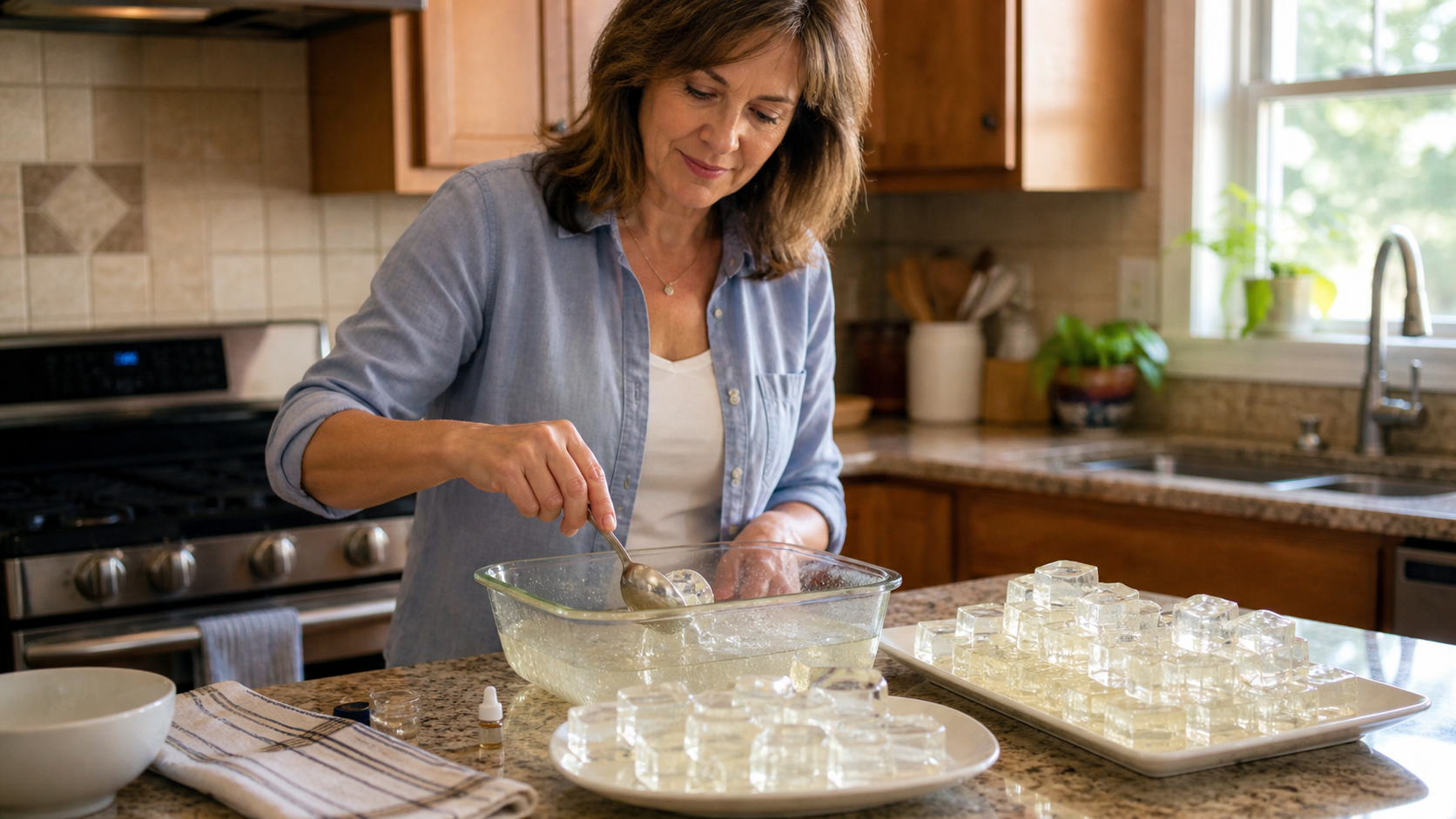
The "green jelly" approach is essentially a way to satisfy all four shifts in one tiny morning step. Women who add it consistently report visible bloat reduction in 7 to 10 days, real belly composition change at the 30-day mark, and — almost universally — fewer hot flashes and better sleep as a quiet bonus.
The 30-Second Morning Routine Most Women in Our Community Are Using
If you'd like the simplest version of everything described above — bovine gelatin, green tea extract, the lemon-peel bioactive, premeasured into one 30-second morning routine — this is the version most readers ask us about. It was designed specifically for women over 50 navigating menopause weight gain, and it's the one we point them to first.
See How Women 40+ Are Doing ItChapter 05The "Bariatric Gelatin Recipe" Trend, Honestly Explained
If you've spent any time on Pinterest, TikTok, or YouTube in the last six months, you've seen it: women searching for the bariatric gelatin recipe, the gelatin weight loss recipe, the "green jello diet," the "morning gelatin trick." The volume of searches has roughly tripled since the beginning of the year. The question is: what is it, and is any of it real?
Here's the honest version, with the science separated from the noise.
Why "bariatric"?
The name comes from a parallel — not a literal one. Bariatric surgery (gastric sleeve, gastric bypass) is the most aggressive weight-loss intervention in modern medicine. The reason it works is not, as most patients are told, the smaller stomach. It's the flood of GLP-1 the surgical alteration releases — the same satiety hormone we've been talking about throughout this article.
What clinicians began noticing is that two amino acids found naturally in pure bovine gelatin — glycine and alanine — appear to support the body's own GLP-1 production through a different, gentler mechanism. Not surgery. Not synthetic injection. Just food. The "bariatric" in the name refers to the target (the GLP-1 satiety pathway), not the procedure.
What the recipe actually is
The protocol most women follow has four ingredients, costs roughly $2 a day at any grocery store, and takes about 30 seconds to prepare in the morning on an empty stomach:
- Pure unflavored bovine gelatin. Not Jello. Not flavored. Not pork. Bovine gelatin is the only common source rich enough in glycine and alanine to matter. Available at most grocery stores in the baking aisle for under $4.
- Green tea extract. The polyphenol component — the "green" in gelatin weight loss recipe variations. Activates the sirtuin cleanup pathway and supports natural fat oxidation.
- A bioactive from lemon peel. Not the juice — the peel. This is the bioactive that, in midlife women's health research, has been shown to ease hot flashes and sleep disruption while supporting the metabolic side.
- One additional natural binder that ensures the amino acids reach the intestine intact. Most viral TikTok versions skip this, which is why they tend not to work.
Why most viral versions don't work
This is the part that makes the most difference. The idea behind the recipe is sound. The execution in most viral videos is broken in one of three ways:
- They use Jello brand (or any flavored gelatin), which contains as much added sugar as a can of soda. The sugar spike directly cancels out any GLP-1 benefit and triggers the insulin response that causes belly fat in the first place.
- They use vegetarian "gelatin" — usually agar — which contains zero glycine or alanine. Mathematically, it cannot produce the GLP-1 effect the recipe is trying to achieve.
- They skip the binder step, so the gelatin protein never reaches the intestine in a form the body can use to support GLP-1 signaling. You end up drinking flavored water with extra steps.
This is why women report the same frustrating pattern: they try the version they saw on social media, see no result in two weeks, and conclude "the gelatin diet doesn't work." The diet works. The version they were given doesn't.
The honest takeaway: the bariatric gelatin recipe for weight loss is a real protocol with sound underlying biology — natural GLP-1 support through specific amino acids found in pure bovine gelatin, paired with polyphenols and a calming bioactive. What's not real is most of what's circulating on TikTok. The right version, prepared the right way, is what the women in our community are actually using.
Chapter 06What About Berberine for Weight Loss After Menopause?
Berberine is everywhere right now — and we get this question almost daily. The honest answer: berberine has real effects, but they're not the effects most women in midlife are hoping for.
Berberine is a plant compound that supports insulin sensitivity. If your fasting blood sugar is elevated, berberine will probably help bring it down. If your A1C is borderline, berberine may help with that, too. These are real, measurable benefits.
What berberine doesn't do? It doesn't address the estrogen-driven part of menopause weight gain. It doesn't restore GLP-1 signaling the way collagen-glycine appears to. It doesn't redistribute visceral fat. So women who try berberine for weight loss often report a version of: "my blood sugar got better, but my belly didn't." That's not berberine failing. That's berberine doing what it does — which isn't the same thing as what menopause weight loss actually requires.
If you're going to take it, take it for blood-sugar support and have realistic expectations about belly fat. (And, as with anything you put into your body, talk to whoever knows your individual history before starting something new.)
Chapter 07The 30-Day Rule for Women in Midlife
If you take nothing else from this article, take this: give any new approach 30 days before deciding it doesn't work.
Not 7 days. Not 14. Thirty.
The reason is biological. After menopause, your body needs roughly 21 to 28 days to recalibrate its metabolic baseline whenever you change inputs. Most women quit at day 9, see "no results," and conclude their body is broken. It isn't. It's just slower to respond than it was at 35 — and it's also more rewarding when it finally does, because the changes that take hold tend to stay instead of bouncing back the way they did in your 30s.
The women in our community who lose the menopause belly successfully share one thing in common: they treated weight loss after 50 as a 90-day project, not a 90-second decision.
The Takeaway
You don't have a willpower problem. You have an information problem.
The diets you've been handed were written for a different woman, a different body, a different decade of your life. The body you have at 47 — even at 67 — still responds to inputs. Just different inputs. Plant pigments. Collagen-glycine. A bioactive from lemon peel. A consistent morning step. Patience for 30 days.
That's it. That's the whole protocol most women find their way to eventually — usually after years of trying everything else first.
If you'd like more context on how women in their 40s, 50s, and 60s are approaching weight loss after menopause, our recommended reading list lives at Metabolic Daily — some of the most readable midlife coverage on the internet.